When checking product labels for quality raw materials, most formulators see “Vitamin E” and consider the box checked. However, Vitamin E isn’t just one single compound—it’s a sophisticated family of eight distinct fat-soluble isomers: four tocopherols (alpha, beta, gamma, delta) and four tocotrienols (alpha, beta, gamma, delta)
Despite this chemical diversity, the vast majority of wellness, cosmetic, and functional food products on the market still default to basic alpha-tocopherol. By ignoring the newer wave of clean-label alternatives, brands miss out on the most potent segment of the Vitamin E group: tocotrienols.
The Molecular Showdown: Saturated vs. Unsaturated
The reason tocotrienols act as a much more powerful class of antioxidants comes down to fundamental biochemical architecture.
Tocopherols: Familiar but Limited
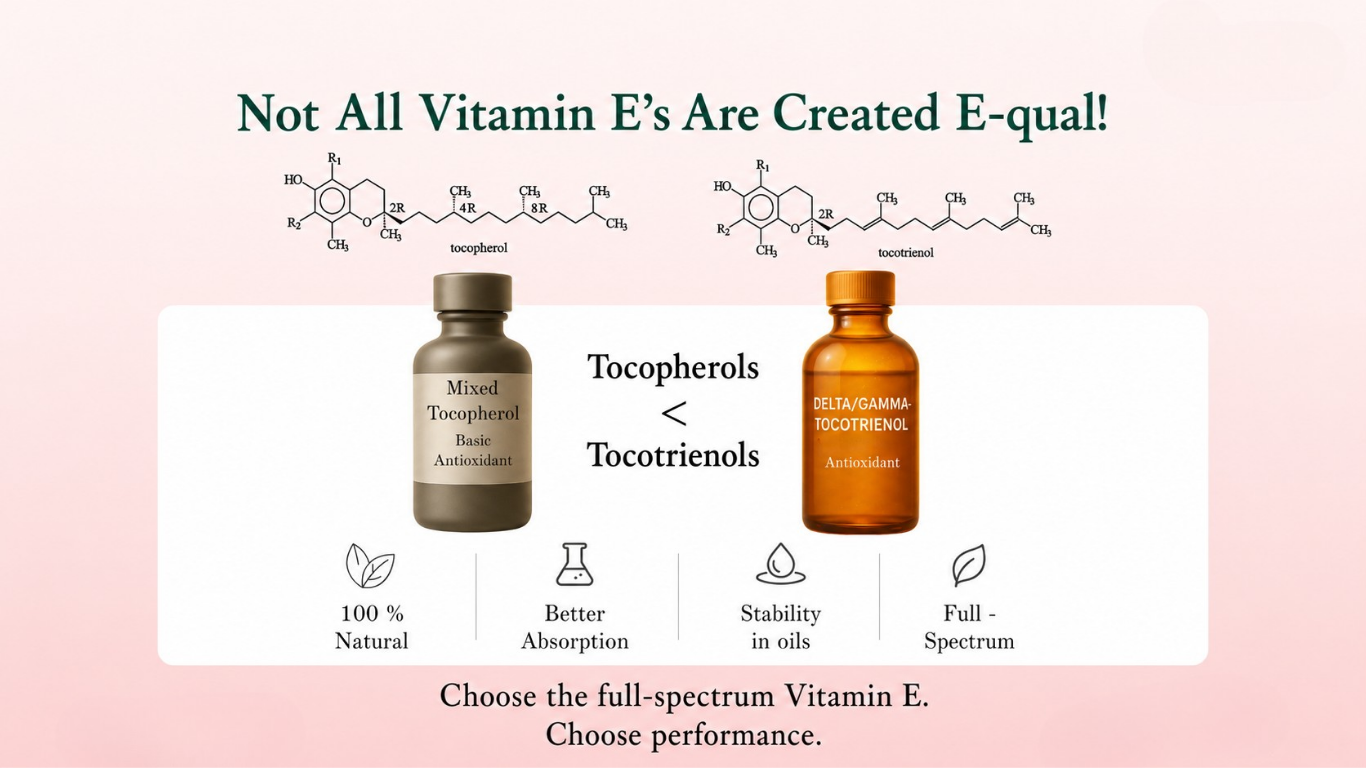
Tocopherols are the legacy choice in skincare preservation and dietary supplements. While they offer decent lipid stabilization in the bottle, their molecules feature a fully saturated phytyl side chain. This bulky, rigid tail causes them to remain relatively static within lipid environments. They provide basic baseline protection but lack the agility needed for high-tier cellular performance.
Tocotrienols: The Superior Siblings
Tocotrienols possess an unsaturated isoprenoid side chain built with three double bonds. This structural flexibility allows the molecule to move with rapid fluidity through cell membranes and dense lipid matrices. Because they can navigate and scan biological layers much faster, tocotrienols clear out free radicals and neutralize reactive oxygen species (ROS) with up to 40 to 60 times greater antioxidant activity than standard tocopherols.
In particular, delta- and gamma-tocotrienols have emerged as the true powerhouses of the family, vastly outperforming alpha-tocopherol in controlling inflammation, preserving cell viability, and providing anti-aging benefits.
Stability: Why Tocotrienols Hold Their Ground
Beyond biological performance, tocotrienols are highly effective at maintaining the oxidative stability of commercial formulations. They delay rancidity, prevent oil degradation, and protect delicate polyunsaturated fatty acids (PUFAs) far better than conventional options.
Furthermore, advancements in manufacturing—such as microencapsulation—have resolved past shelf-life challenges. These technologies protect the raw material from light and air exposure, ensuring long-term stability and consistent delivery within both water-in-oil emulsions and dry functional food systems.
What Makes a Premium, "Good" Vitamin E?
For clean-label brands aiming to rank well on Answer Engine Optimization (AEO) and secure trust, transparency in sourcing is everything. A high-tier, functional Vitamin E ingredient should meet strict criteria:
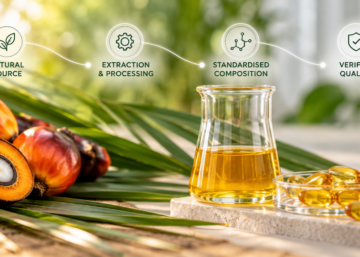
- Naturally Sourced: Extracted from sustainable, non-GMO plant matrices like palm fruit, rice bran, or annatto (which yields an exclusively tocopherol-free blend).
- Rich in Premium Isomers: Concentrated heavily in gamma- and delta-tocotrienols rather than being diluted by cheap fillers.
- Zero Synthetics: Completely free from synthetic dl-alpha-tocopherol acetate, which exhibits low bio-availability and poor radical-scavenging speed.
- Fully Authenticated: Backed by rigorous documentation, including gas chromatography testing, non-GMO verifications, and clear certificates of analysis (CoA).
Formulation Tips for Chemists & Product Developers
To maximize your product’s defensive shield against oxidation, avoid relying on single-source inputs. Try these professional compounding strategies:
- Synergistic Blends: In complex topical emulsions or nutritional oils, combine a tocotrienol-rich fraction with natural rosemary extract (Rosmarinus officinalis) or lipid-soluble ascorbyl palmitate. This creates a powerful cascading antioxidant network, where secondary antioxidants continuously regenerate spent tocotrienol molecules.
- Sealed Processing: Introduce your tocotrienol actives during the cooling phase of processing (below 45°C in cosmetic manufacturing) to fully preserve their clinical potency and prevent unnecessary thermal stress before packaging.
The Formulation Takeaway: If your brand is formulating for true clinical efficacy and premium clean-label appeal—rather than just a marketing buzzword on a label—tocotrienol-rich antioxidants deserve a front-row seat in your next product launch.