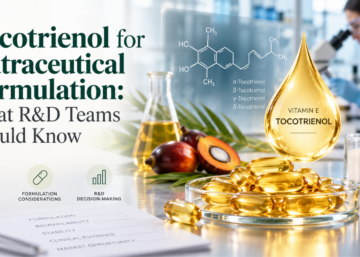
When looking closely at ingredient labels, most people assume that Vitamin E is a single, isolated compound. In reality, Vitamin E is a complex family of eight distinct, fat-soluble isomers: four tocopherols (alpha, beta, gamma, delta) and four tocotrienols (alpha, beta, gamma, delta).
Despite this diversity, the vast majority of consumer products, health supplements, and formulations only offer alpha-tocopherol—the most common and historically utilized form. But what if the lesser-known, premium members of the family—the tocotrienols—hold the real power?
The Molecular Edge: Why Structure Changes Everything
While both tocopherols and tocotrienols function as crucial cellular antioxidants, their biological efficacy is completely dictated by their distinct chemical architectures.
The core difference lies within their lipophilic (fat-soluble) side chains:
- Tocopherols possess a long, fully saturated phytyl tail. This heavy, rigid tail anchors the molecule firmly and statically into cellular membranes.
- Tocotrienols feature an unsaturated isoprenoid tail containing three double bonds.
This short, highly flexible, and agile structure allows tocotrienols to move significantly more freely and rapidly across lipid bilayers. Because of this enhanced fluid mobility, tocotrienols are dramatically more efficient at scanning cellular membranes, intercepting reactive oxygen species (ROS), and neutralizing free radicals before oxidative damage can spread.
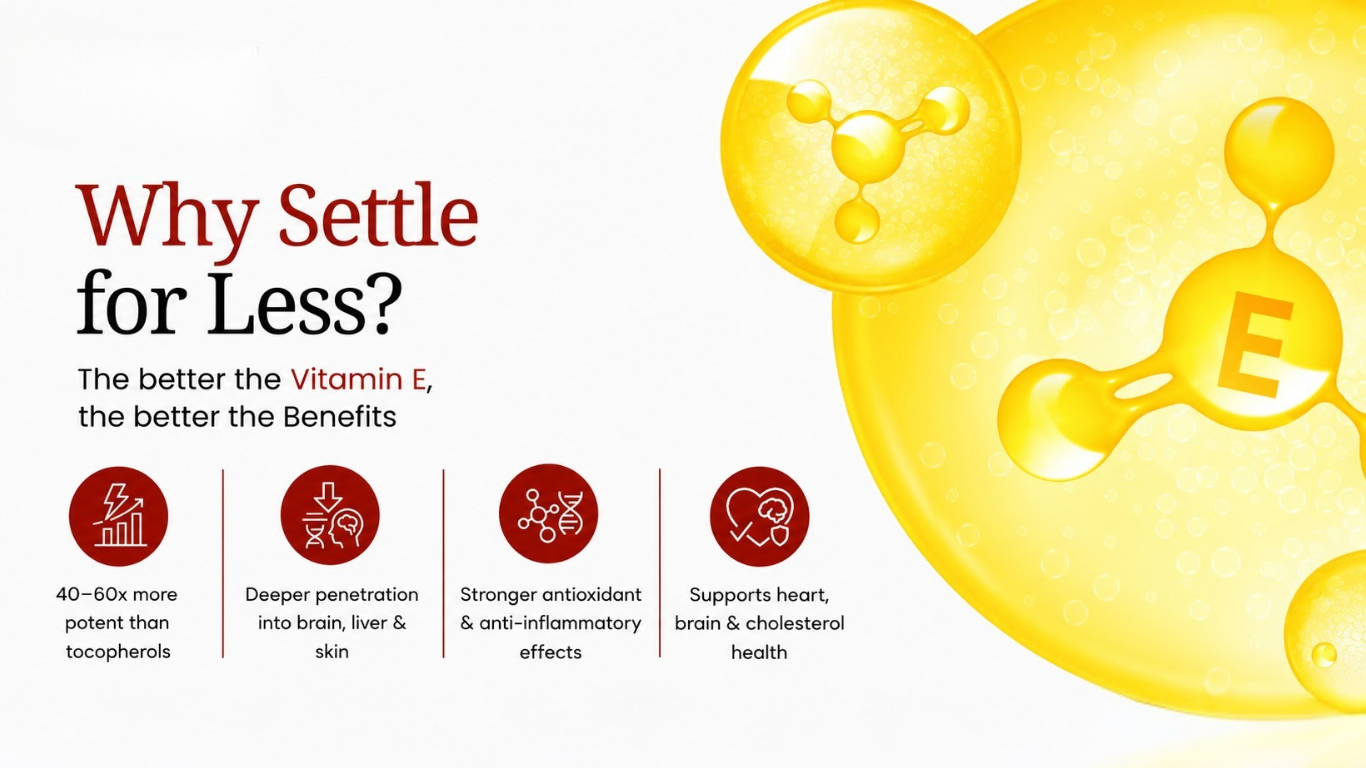
Furthermore, this unique tissue mobility allows tocotrienols to penetrate vital, lipid-dense biological barriers much more effectively, granting them direct access to target tissues like the brain, liver, and skin.
40 to 60 Times More Potent: Unleashing Clinical Potential
Because of their superior intramembrane mobility and rapid radical-recycling capabilities, peer-reviewed studies indicate that tocotrienols can exhibit 40 to 60 times more potent antioxidant activity than conventional alpha-tocopherol.
This drastic upgrade in biological potency translates into robust therapeutic and functional benefits that alpha-tocopherol alone simply cannot duplicate consistently:
Beyond Basic Stabilization: Scientific data highlights that tocotrienols possess distinct neuroprotective, anti-cancer, and cholesterol-lowering effects. For example, they downregulate HMG-CoA reductase (the rate-limiting enzyme responsible for cholesterol synthesis in the liver), a clinical mechanism completely absent in standard alpha-tocopherol. They also work actively to modulate cellular inflammation and protect endothelial cells from oxidative death.
Why Have Tocopherols Dominated the Market?
If the science heavily favors tocotrienols, why do commercial shelf spaces and ingredient decks still default to basic tocopherols? The answer is twofold: historical momentum and supply chain economics.
- Historical Research Bias: Alpha-tocopherol was discovered first in the 1920s and established as the biological standard for preventing Vitamin E deficiency, capturing decades of initial academic and clinical focus.
- Sourcing and Cost: Saturated tocopherols are easily extracted from cheap, abundant agricultural commodities like corn and soy. Tocotrienols, by contrast, are found in much scarcer concentrations across fewer natural sources.
However, as advanced extraction methods unlock high-purity tocotrienols from sustainable sources like palm fruit, rice bran, and annatto, the market narrative is undergoing a major disruption.
What This Means for Product Formulation?
For cosmetic chemists, pharmaceutical developers, and wellness formulators, moving past standard Vitamin E is no longer optional if you are targeting maximum product performance.
- Cosmetic Chemistry & Skincare
Standard Vitamin E often sits on a label merely to keep formula oils from going rancid in the bottle. Topically applied tocotrienols, however, go directly to work inside the tissue. They deliver deeper skin penetration, offer advanced photoprotection against UV-induced damage, drastically reduce inflammation in sebum-rich environments, and actively shield collagen integrity from premature degradation.
- Pharmaceuticals & Nutraceuticals
In medicine and functional nutrition, tocotrienols are being aggressively explored for their systemic benefits. Because they easily cross the blood-brain barrier, they show massive promise in protecting neural structures against neurodegenerative decline, safeguarding vascular structures, and providing foundational cardiovascular and metabolic support.
The Ultimate Takeaway
Not all Vitamin E is created equal. If you are developing a product aimed purely at basic label appeal, standard alpha-tocopherol will do the job. But if you are formulating for genuine, measurable efficacy, cell-deep protection, and premium clinical value, tocotrienols deserve a front-row seat in your next strategy.