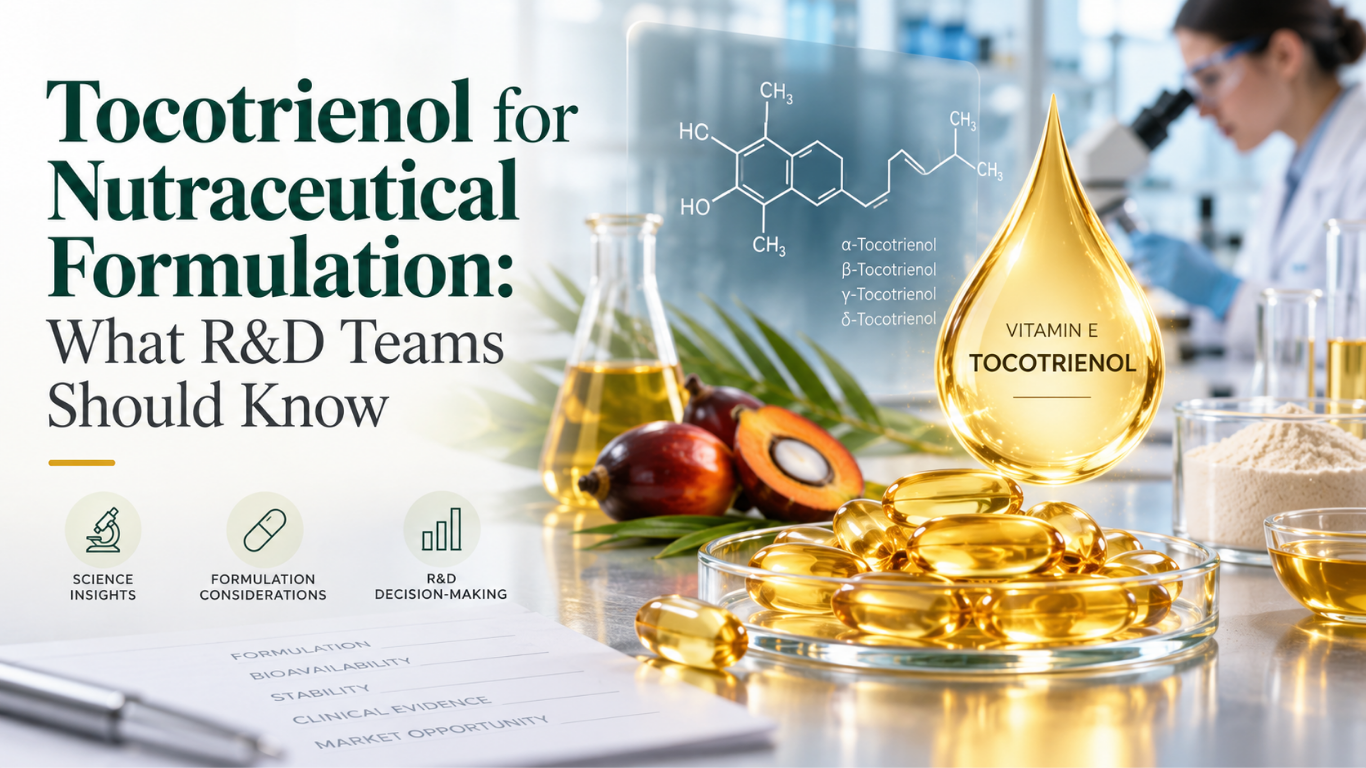
Tocotrienol for Nutraceutical Formulation: What R&D Teams Should Know
Selecting a tocotrienol ingredient is a technical decision. The name on a specification sheet tells only part of the story. R&D teams need to understand source, isomer profile, concentration, purity, analytical methods, stability, delivery format, regulatory requirements and the intended finished-product application. As interest in specialised vitamin E ingredients grows, a structured evaluation process can help manufacturers move from ingredient discovery to robust formulation.
What is tocotrienol used for in nutraceuticals?
Tocotrienols are vitamin E family compounds investigated for nutritional and biological properties. Research has explored antioxidant activity, lipid metabolism, inflammation-related pathways and other mechanisms. However, the evidence differs by outcome and study type. A nutraceutical formulation should therefore be designed around a clearly defined nutritional purpose and compliant claims rather than broad therapeutic language.
Start with identity and source
The first question should be: what exactly is the ingredient? Ask for the botanical source, manufacturing route, identity testing and composition. Natural sources can contain mixtures of tocotrienol isomers and tocopherols. The ratio can vary considerably. If the product is standardised, the standardisation target should be clearly stated.
Understand concentration and isomer profile
A label saying ‘tocotrienol’ is incomplete from an R&D perspective. The team should know the concentration of total tocotrienols and, where relevant, the individual alpha-, beta-, gamma- and delta-isomer profile. This matters because the scientific literature may refer to specific isomers or mixtures. A formulation decision should therefore match the ingredient specification to the evidence supporting the intended positioning.
Purity and analytical testing
Purity should be interpreted according to the supplier’s defined specification and validated analytical method. R&D teams should review the certificate of analysis, test methods, specification limits and identity criteria. Where the ingredient is sensitive to oxidation, stability-related parameters should also be considered.
Bioavailability and delivery considerations
Tocotrienols are lipophilic compounds. Their absorption and distribution have been studied in human and experimental settings, and formulation can influence how lipophilic ingredients behave. A nutraceutical developer should consider dosage form, oil phase, excipients, encapsulation or other delivery approaches where appropriate. The correct approach depends on the ingredient and finished-product design.
Stability is a formulation question
The stability of a finished nutraceutical depends on the whole system. Oxygen exposure, light, temperature, water activity, packaging and interactions with other ingredients can influence shelf life. Tocotrienol ingredients should therefore be evaluated under relevant accelerated and real-time stability conditions rather than relying only on a raw-material stability statement.
Regulatory and claims review
Before commercialisation, the formulation and claims should be reviewed against the requirements of the target market. Scientific literature can inform product development, but it does not automatically make every health claim permissible. This is especially important when translating mechanistic or clinical research into consumer-facing language.
R&D checklist
A practical checklist includes: botanical source; extraction/manufacturing information; total tocotrienol concentration; isomer profile; tocopherol content; identity method; purity specification; residuals and contaminants as applicable; stability data; recommended storage; packaging compatibility; regulatory documentation; allergen information where relevant; and certificate of analysis.
Conclusion
Tocotrienol can be a valuable ingredient for nutraceutical developers exploring differentiated vitamin E formulations, but successful development depends on technical detail. The best supplier relationship is not based only on a headline concentration. It is based on transparent composition, consistent quality, analytical confidence, application support and responsible scientific communication.
FAQs
Tocotrienol is a subgroup of the vitamin E family comprising alpha-, beta-, gamma- and delta-tocotrienol.
Yes. Tocotrienols are members of the naturally occurring vitamin E family.
The key structural distinction is the side chain: tocopherols have a saturated phytyl side chain, while tocotrienols have an unsaturated isoprenoid side chain.
Research has investigated their antioxidant activity, metabolism, membrane behaviour and other biological properties. The strength of evidence varies by outcome and study type.
Source, identity, total concentration, isomer profile, purity, analytical method, stability, storage, regulatory documentation and application suitability are useful starting points.