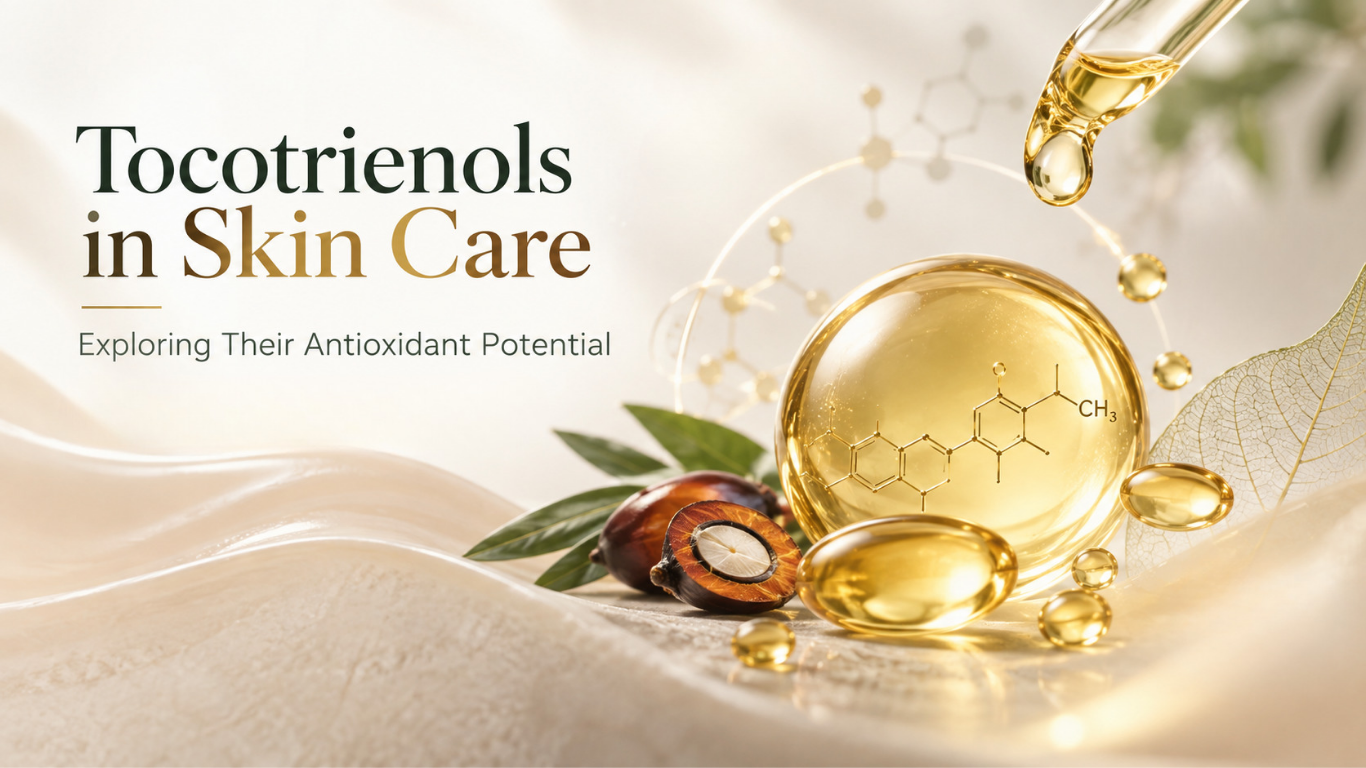
Tocotrienols in Skin Care: Exploring Their Antioxidant Potential
Vitamin E has a long history in cosmetic and personal-care formulations, particularly because of its role as a lipid-phase antioxidant. Within the vitamin E family, tocotrienols are receiving increasing scientific attention. Their unsaturated side chain, antioxidant properties and interaction with lipid environments make them an interesting subject for skin-care research. For cosmetic formulators, however, the important question is not simply whether tocotrienol is ‘better’ than another form of vitamin E. The more useful question is what the ingredient brings to a formulation, what the evidence actually demonstrates and how its quality and stability can be controlled.
What are tocotrienols in skin care?
Tocotrienols are naturally occurring members of the vitamin E family. They include alpha-, beta-, gamma- and delta-tocotrienol. In cosmetic science, they are investigated primarily in the context of antioxidant and skin-protective applications. The skin is continuously exposed to environmental factors, including ultraviolet radiation and other sources of oxidative stress. Antioxidant ingredients are therefore widely studied as part of strategies for supporting cosmetic product performance and skin appearance. Research on tocotrienols includes laboratory, animal and some human studies, but the evidence base is not uniform across every application.
Why are antioxidants important in cosmetic formulations?
Oxidation can affect both the skin environment and the formulation itself. In a cosmetic product, oxidation of oils and other susceptible components can contribute to quality deterioration. In skin biology, oxidative processes are associated with environmental stress and ageing-related changes. Lipid-soluble antioxidants such as vitamin E compounds are therefore relevant to cosmetic science. Their role should be described carefully: an antioxidant property observed in an ingredient or formulation does not automatically establish a clinical anti-ageing effect in consumers.
Tocotrienols and skin research
A systematic review of tocotrienol research on skin ageing examined evidence relating to pigmentation, moisture, wrinkles, ultraviolet exposure and related outcomes. The review reported promising findings but also highlighted limitations, including the need for more research on several endpoints and formulation strategies. This distinction is important for responsible website content. Orah Nutrichem can communicate that tocotrienols are being investigated for skin-related applications without converting preliminary or limited evidence into guaranteed cosmetic outcomes.
Tocotrienol versus tocopherol in cosmetic thinking
Tocopherols are established vitamin E ingredients in cosmetics. Tocotrienols are chemically related but structurally distinct. Their unsaturated side chain changes their physical and biological behaviour, which is one reason researchers study them separately. A formulator should not choose between tocopherol and tocotrienol based on a generic claim that one is always superior. The decision should consider the desired product function, ingredient concentration, formulation system, stability, sensory requirements, analytical specification and applicable regulations.
Where could tocotrienols fit in modern skin care?
Potential cosmetic applications include antioxidant-focused facial products, oils, emulsions, serums and other formulations where a lipid-compatible vitamin E ingredient is appropriate. The final application depends on the specific ingredient and formulation system. Compatibility testing, stability testing and appropriate packaging are important because oxidative stability is a formulation-level question, not simply a property of one ingredient.
What should cosmetic R&D teams evaluate?
Key questions include ingredient identity, tocotrienol profile, concentration, purity, carrier system, appearance, odour, oxidative stability, recommended storage, compatibility with oils and emulsifiers, processing temperature, packaging and analytical testing. R&D teams should also check the regulatory status and permitted cosmetic claims in the markets where the finished product will be sold.
How can brands communicate tocotrienol responsibly?
Good cosmetic communication focuses on ingredient facts and formulation relevance. Statements such as ‘contains tocotrienol, a member of the vitamin E family’ are straightforward. Claims about antioxidant activity should be supported by suitable evidence and should not imply treatment of a disease. If a finished product makes a specific skin-benefit claim, that claim should be supported by appropriate finished-product evidence rather than relying solely on literature about the raw material.
Conclusion
Tocotrienols represent an interesting area of modern cosmetic ingredient research. Their vitamin E identity, lipid compatibility and antioxidant research make them relevant to formulators exploring differentiated ingredients. The strongest opportunity for ingredient brands is to combine scientific education with transparent quality information. For Orah Nutrichem, a science-led explanation of tocotrienol can help cosmetic R&D teams understand not only what the molecule is, but also what questions they should ask before incorporating it into a finished formulation.
FAQs
Tocotrienol is a subgroup of the vitamin E family comprising alpha-, beta-, gamma- and delta-tocotrienol.
Yes. Tocotrienols are members of the naturally occurring vitamin E family.
The key structural distinction is the side chain: tocopherols have a saturated phytyl side chain, while tocotrienols have an unsaturated isoprenoid side chain.
Research has investigated their antioxidant activity, metabolism, membrane behaviour and other biological properties. The strength of evidence varies by outcome and study type.
Source, identity, total concentration, isomer profile, purity, analytical method, stability, storage, regulatory documentation and application suitability are useful starting points.