Why Is Tocotrienol Gaining Attention in Modern Nutrition?
Target length: approximately 2,000 words when expanded/edited to the final publishing specification
Vitamin E is often discussed as though it were a single nutrient. In reality, vitamin E refers to a family of related fat-soluble compounds, including tocopherols and tocotrienols. As nutrition science and ingredient development become more precise, attention is increasingly moving beyond alpha-tocopherol to the wider vitamin E family. Tocotrienols are one part of that conversation. Their distinct molecular structure, occurrence in selected plant oils and growing body of research make them an interesting ingredient for modern nutrition and nutraceutical formulation.
What is tocotrienol?
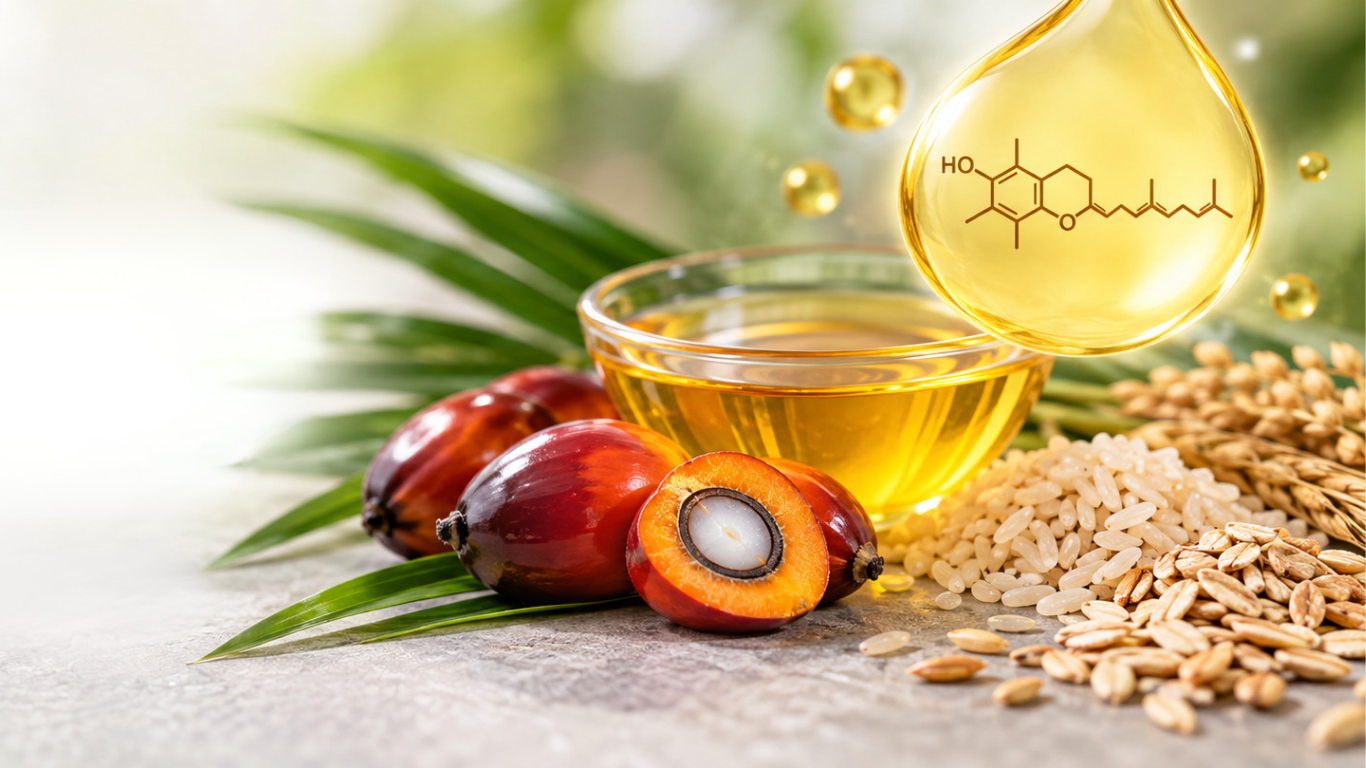
Tocotrienols are four members of the vitamin E family: alpha-, beta-, gamma- and delta-tocotrienol. Together with the four tocopherols, they form the eight naturally occurring vitamin E compounds commonly described in scientific literature. Tocotrienols share the chromanol ring characteristic of vitamin E, but their side chain contains three double bonds, whereas tocopherols have a saturated phytyl side chain. This structural distinction is more than a chemistry detail: it influences how the molecules behave in lipid environments and helps explain why researchers study tocotrienols separately from tocopherols. Reviews of the literature describe tocotrienols in plant-derived oils including palm, rice bran and some grains and nuts. Their distribution and composition depend strongly on the botanical source and processing route.
Why is modern nutrition looking beyond alpha-tocopherol?
Alpha-tocopherol has historically dominated vitamin E nutrition because it is the form preferentially retained by the human body and is the form used by several authorities when defining vitamin E nutritional reference values. At the same time, scientific research has continued to investigate the other vitamin E isoforms. Tocotrienols have attracted interest because they are not simply interchangeable with tocopherols at the molecular level. Research has explored their antioxidant activity, membrane behaviour, metabolism and other biological effects. This does not mean that tocotrienols should be presented as universally superior to tocopherol. Rather, the key point for ingredient science is that the vitamin E family contains chemically distinct compounds with different properties and research profiles.
Tocotrienol and antioxidant science
One of the central areas of tocotrienol research is antioxidant activity. Vitamin E compounds can participate in lipid-phase antioxidant systems, where they help interrupt oxidative chain reactions involving lipids. Tocotrienols have been studied in model systems, cell studies, animal studies and human research. Some experimental studies have reported differences among vitamin E isoforms, including differences in membrane distribution and antioxidant behaviour. However, antioxidant activity measured in a laboratory system should not automatically be translated into a clinical health claim. For nutrition brands and ingredient suppliers, the responsible approach is to describe the evidence accurately, identify the type of study, and avoid implying that an ingredient has a disease-preventing or disease-treating effect unless an appropriate regulatory framework and evidence support such a claim.
Natural sources of tocotrienols
Tocotrienols occur naturally in selected plant-derived materials. Scientific reviews identify sources such as palm oil, rice bran, barley, oats and certain other plant oils and grains. The amount and ratio of individual tocotrienol isomers can vary with botanical source, cultivar, growing conditions, extraction method and processing. This variation is important from a formulation perspective. A statement such as ‘natural tocotrienol’ does not by itself communicate the concentration, isomer profile, purity, stability or specification of an ingredient. R&D teams should therefore evaluate the complete technical documentation rather than relying only on the ingredient name.
What does tocotrienol mean for nutraceutical formulation?
For a nutraceutical developer, the value of a tocotrienol ingredient is not determined by the molecule alone. The practical questions include concentration, isomer distribution, carrier or delivery system, physical form, oxidative stability, compatibility with the finished formulation, analytical specification and intended dose. Formulators also need to understand the regulatory status of the ingredient in the target market and the claims that can legally be made. These considerations become especially important when a brand wants to communicate a natural, science-led positioning.
What should an R&D team ask an ingredient supplier?
A useful technical checklist includes: What is the botanical source? What tocotrienol isomers are present? What is the declared concentration? What analytical method is used? What are the specification limits? How is identity confirmed? What is the shelf life and recommended storage condition? What documentation is available for quality, safety and regulatory review? Is the ingredient suitable for the intended dosage form? Asking these questions early reduces formulation surprises later.
Tocotrienol and the future of nutrition ingredients
The interest in tocotrienols reflects a broader movement in nutrition toward ingredient specificity. Instead of treating broad ingredient names as sufficient, formulators increasingly want to understand molecular composition, source, standardisation and application performance. Tocotrienols fit naturally into this conversation because they illustrate how one nutrient family can contain multiple distinct molecules. For Orah Nutrichem, this creates an opportunity to communicate vitamin E science in a way that is useful to R&D teams rather than simply repeating consumer-level benefit statements.
Conclusion
Tocotrienol is gaining attention because it expands the way we understand vitamin E. It is a distinct subgroup of the vitamin E family, has identifiable natural sources and has generated a growing research literature. For modern nutrition, the most useful perspective is not to ask whether tocotrienol should replace every other form of vitamin E, but to understand where its unique molecular characteristics and formulation requirements may be relevant. Good ingredient selection begins with science, continues with quality and specification, and ends with a formulation that is appropriate for its intended use.
FAQs
Tocotrienol is a subgroup of the vitamin E family comprising alpha-, beta-, gamma- and delta-tocotrienol.
Yes. Tocotrienols are members of the naturally occurring vitamin E family.
The key structural distinction is the side chain: tocopherols have a saturated phytyl side chain, while tocotrienols have an unsaturated isoprenoid side chain.
Research has investigated their antioxidant activity, metabolism, membrane behaviour and other biological properties. The strength of evidence varies by outcome and study type.
Source, identity, total concentration, isomer profile, purity, analytical method, stability, storage, regulatory documentation and application suitability are useful starting points.