Understanding Tocotrienol Concentration, Purity and Standardisation
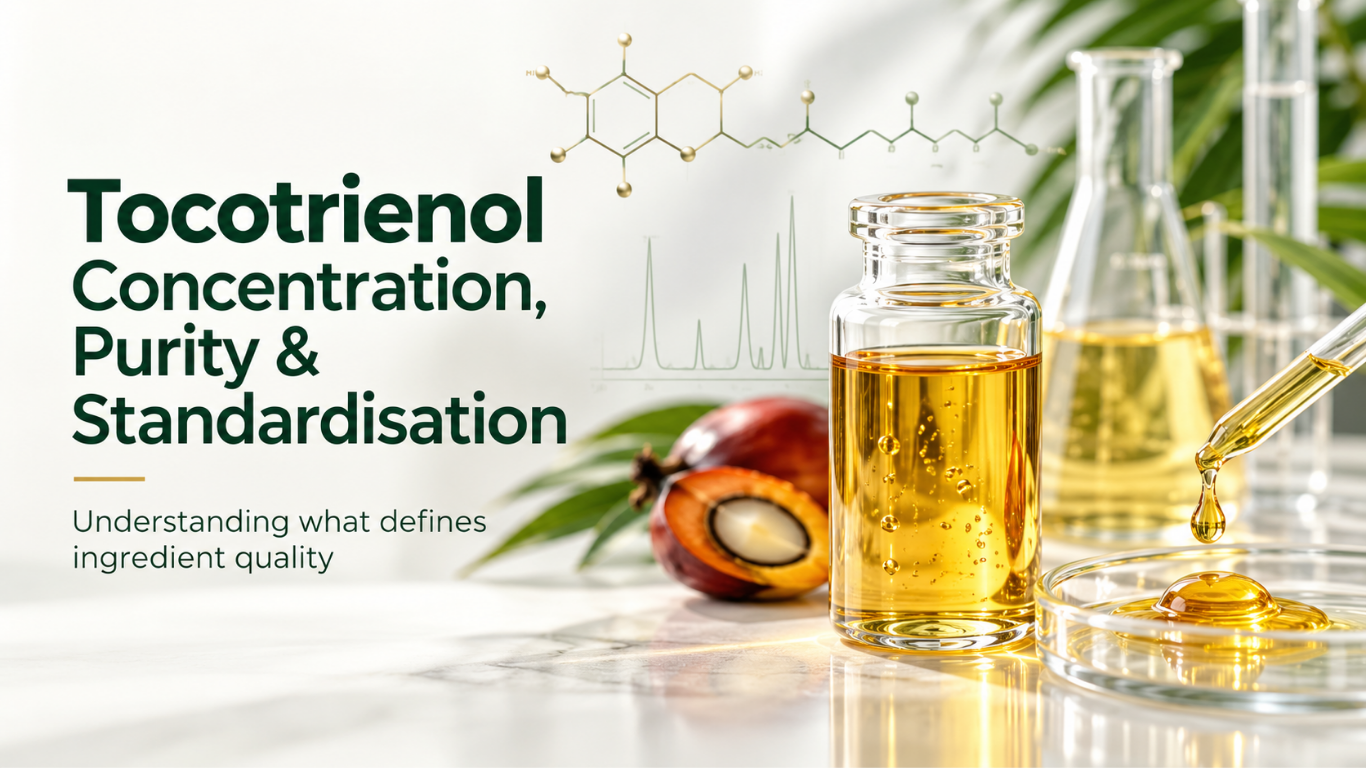
Concentration, purity and standardisation are three terms that often appear together in ingredient discussions, but they do not mean the same thing. For tocotrienol ingredients, understanding these concepts is essential because the vitamin E family contains multiple related molecules and natural sources can vary in composition. A clear technical specification helps R&D, procurement and quality teams evaluate an ingredient consistently.
What does tocotrienol concentration mean?
Concentration describes how much of a specified component or group of components is present in an ingredient according to a defined analytical method. For example, a specification may declare total tocotrienols or individual isomers. The exact meaning should always be read alongside the test method and specification.
What is purity?
Purity is a broader quality concept describing the proportion of the desired substance relative to other substances, according to the defined specification. In complex natural ingredients, ‘purity’ should not be interpreted without understanding the composition. A mixture containing several desirable vitamin E homologues may be intentionally manufactured as a standardised ingredient.
What is standardisation?
Standardisation means controlling an ingredient to a defined compositional or quality target. It can help manufacturers achieve greater batch-to-batch consistency. For a tocotrienol ingredient, standardisation might relate to total tocotrienols, a defined isomer distribution or another measurable quality attribute.
Why does analytical method matter?
A numerical result has meaning only in the context of the method used to obtain it. HPLC and related chromatographic methods are commonly used to separate and quantify vitamin E compounds. The specification should identify the analytical approach and acceptance criteria so quality teams can interpret results consistently.
How should R&D teams read a specification sheet?
Start with identity. Then review assay or concentration, isomer profile, relevant impurities, physical characteristics, storage conditions and shelf life. Check whether the test method and units are clearly stated. If a value is critical to dosage or claims, confirm the calculation basis and whether the declared value is minimum, typical or target.
Why consistency matters in formulation
Inconsistent raw materials can affect dosage, sensory properties, stability and finished-product performance. Standardised ingredients help reduce variability, but the finished product still needs its own quality and stability controls. Raw-material standardisation is a tool for consistency, not a substitute for finished-product testing.
Concentration is not the same as performance
A higher numerical concentration does not automatically mean better performance. Performance depends on the chemical form, formulation matrix, stability, delivery system, intended use and other variables. This is particularly important when comparing different vitamin E ingredients.
A practical supplier checklist
Ask for: product specification; certificate of analysis; identity method; assay method; isomer profile; typical and minimum values; stability information; storage requirements; batch consistency information; regulatory documents; and application guidance. These documents allow an R&D team to evaluate the ingredient based on evidence rather than marketing language.
Conclusion
Tocotrienol concentration, purity and standardisation are related but distinct concepts. Understanding the difference helps R&D and procurement teams compare ingredients accurately and build reliable formulations. Orah Nutrichem can use this educational approach to show that ingredient quality is not just a number on a brochure—it is a combination of identity, composition, analytical control and consistency.
FAQs
Tocotrienol is a subgroup of the vitamin E family comprising alpha-, beta-, gamma- and delta-tocotrienol.
Yes. Tocotrienols are members of the naturally occurring vitamin E family.
The key structural distinction is the side chain: tocopherols have a saturated phytyl side chain, while tocotrienols have an unsaturated isoprenoid side chain.
Research has investigated their antioxidant activity, metabolism, membrane behaviour and other biological properties. The strength of evidence varies by outcome and study type.
Source, identity, total concentration, isomer profile, purity, analytical method, stability, storage, regulatory documentation and application suitability are useful starting points.