Tocotrienol and Antioxidant Science: What Does the Research Say?
Tocotrienol is often described as an antioxidant, but a science-led discussion needs to ask a deeper question: what does the research actually show? Evidence comes from chemical assays, cell studies, animal models, observational research and human clinical trials, and these levels of evidence should not be treated as equivalent. Understanding the research landscape helps ingredient companies communicate tocotrienol accurately and helps R&D teams evaluate where the ingredient may fit.
What is antioxidant activity?
Oxidation is a chemical process that can generate reactive species and affect lipids, proteins and other biological components. Antioxidants can interrupt or modulate oxidative processes through different mechanisms. Vitamin E compounds are particularly relevant to lipid environments because of their fat-soluble nature.
Why are tocotrienols studied as antioxidants?
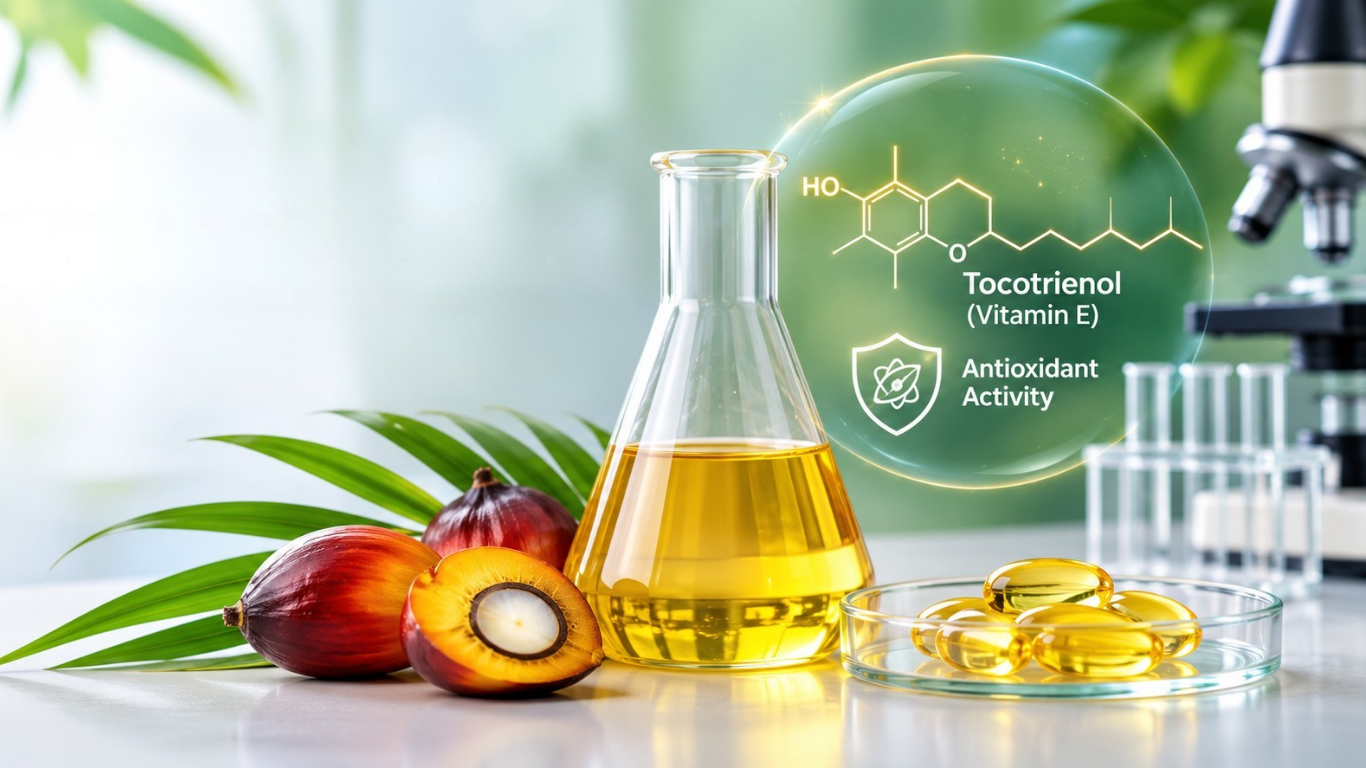
Tocotrienols have a chromanol ring capable of participating in radical-scavenging chemistry and an unsaturated side chain that distinguishes them from tocopherols. Experimental studies have investigated their behaviour in membranes and lipid systems. Some studies report differences among vitamin E isoforms, but results depend on the experimental model.
What do laboratory studies tell us?
In vitro studies can help researchers understand molecular interactions, antioxidant capacity and pathways. They are useful for hypothesis generation and mechanism exploration. However, an effect in a chemical assay or cultured cell does not establish that the same effect occurs at the same magnitude in humans after oral intake or topical application.
What do animal studies tell us?
Animal studies provide a more integrated biological model, including absorption, metabolism and tissue distribution. They can help researchers investigate mechanisms and dose-response relationships. Still, animal findings cannot automatically be translated into human efficacy.
What do human studies tell us?
Human studies are especially important when evaluating nutritional or clinical outcomes. Reviews of tocotrienol research have identified human trials but also note limitations in areas such as sample size, bioavailability and heterogeneity of study designs. Therefore, website content should distinguish promising evidence from established outcomes.
Antioxidant activity is not a disease claim
A responsible ingredient article should avoid turning antioxidant research into claims that an ingredient prevents or treats a specific disease. The correct communication is to describe the scientific property, cite the evidence and state the limitations. This is especially important for nutraceutical content.
Why bioavailability matters
A molecule’s activity in a laboratory system is only one part of the story. For an orally consumed ingredient, absorption, metabolism, distribution, dose and formulation all influence exposure. For topical use, penetration, vehicle, concentration and skin compatibility matter. This is why formulation science and biological evidence need to be considered together.
What research questions remain?
Important areas include improving delivery and bioavailability, understanding isomer-specific activity, defining appropriate doses, comparing formulations and conducting well-designed human studies. The research field continues to develop, making careful interpretation particularly important.
Conclusion
The scientific literature supports continued interest in tocotrienols as bioactive vitamin E compounds with antioxidant and other investigated properties. At the same time, evidence varies by model and outcome. The strongest communication approach is transparent: explain what is known, identify what is still being studied, and connect ingredient science to practical formulation considerations.
FAQs
Tocotrienol is a subgroup of the vitamin E family comprising alpha-, beta-, gamma- and delta-tocotrienol.
Yes. Tocotrienols are members of the naturally occurring vitamin E family.
The key structural distinction is the side chain: tocopherols have a saturated phytyl side chain, while tocotrienols have an unsaturated isoprenoid side chain.
Research has investigated their antioxidant activity, metabolism, membrane behaviour and other biological properties. The strength of evidence varies by outcome and study type.
Source, identity, total concentration, isomer profile, purity, analytical method, stability, storage, regulatory documentation and application suitability are useful starting points.