In a consumer landscape leaning heavily into “natural” and clean-label products, product developers face a critical challenge: achieving long-term shelf life without sacrificing ingredient integrity.
While tocopherols have long been the industry’s default choice for oxidative stability, it is time to turn the spotlight on their lesser-known, highly potent cousins: tocotrienols. Together, these two compound classes make up the Vitamin E family, but their chemical architectures dictate entirely different levels of antioxidant activity.
What Makes Tocotrienols Chemically Superior?
To understand why tocotrienols are a game-changer for shelf-life extension and product preservation, we have to look at their molecular structure.
While tocopherols feature a long, saturated side chain, tocotrienols possess an unsaturated isoprenoid tail containing three double bonds. This structural distinction makes the molecule more compact and flexible, allowing it to:
- Penetrate cell membranes and lipid bilayers with significantly greater efficiency.
- Move rapidly through dense lipid environments to intercept reactive oxygen species (ROS) and clear out free radicals.
- Provide vastly superior protection against lipid peroxidation, rancidity, and chemical degradation.
For formulators working with polyunsaturated fatty acids (PUFAs), delicate botanical extracts, and complex plant-based emulsions, switching to tocotrienols means unlocking a much higher threshold of oxidative protection.
Cross-Industry Applications: Where Science Meets Formulation
- Advanced Cosmetic Formulations
In personal care and cosmetics, an antioxidant cannot just act as a standard container preservative; it needs to offer active skin benefits. Sebum-rich environments are highly prone to lipid peroxidation, which triggers inflammation and acne.
Because tocotrienols seamlessly integrate into the skin’s lipid matrix, they outperform traditional tocopherols by protecting the skin barrier function from environmental oxidative stress. Incorporating them into topical products allows brands to back up critical anti-aging claims, including:
- Photoprotection against UV-induced free radical damage.
- Preservation of collagen integrity and skin elasticity.
- Visible improvements in skin texture and tone.
- High-Performance Nutraceuticals
In dietary supplements and functional foods, tocotrienols pull double duty as both an internal stabilizer and an active bioactive ingredient. Beyond maintaining the potency of raw materials in a softgel or capsule, clinical studies have documented their profound systemic therapeutic benefits:
Dual-Purpose Functionality: Tocotrienols offer targeted support for neuroprotection, cardiovascular health (by managing cholesterol synthesis), and metabolic function.
By pairing basic oxidative stability with high-tier functional health benefits, formulators can design highly marketable products aimed at mood, cognition, and healthy aging.
- Clean-Label Food Innovation
Protecting sensitive oils and micronutrients from thermal oxidation during processing is a major hurdle in food science. Whether you are formulating cold-pressed functional snacks, fortified beverages, or omega-enriched spreads, food matrices are constantly under threat of turning rancid.
Tocotrienols resist degradation even under moderate thermal processing conditions. This heat-tolerant antioxidant capacity stops off-flavors before they start, ensuring your product tastes exactly as intended throughout its entire shelf life—all without relying on synthetic chemical preservatives.
Why They Were Underused—And Why That’s Changing?
If tocotrienols are so effective, why hasn’t everyone switched? Historically, the industry faced two massive bottlenecks: sourcing constraints and prohibitive manufacturing costs.
That dynamic has completely shifted. Thanks to next-generation green chemistry and advanced extraction technologies, manufacturers can now sustainably isolate clean, high-purity tocotrienols at scale from natural sources like palm fruit, rice bran, and annatto.
| Aspect | Traditional Tocopherols | Advanced Tocotrienols |
|---|---|---|
| Primary Structure | Saturated side chain (bulky) | Unsaturated side chain (compact/agile) |
| Mobility in Lipids | Slower distribution | Rapid mobility & higher radical-clearing speed |
| Key Benefit | Baseline formula stabilization | Dual-action: Formula protection + clinical efficacy |
| Sourcing | Soy, corn, synthetic blends | Sustainable palm, rice bran, annatto |
Formulators: It’s Time to Rethink Your Antioxidant Strategy
When choosing raw materials for your next launch, ask yourself: Are you settling for an ingredient that merely stabilizes your formula, or are you choosing one that actively strengthens your brand’s clinical science, efficacy, and purpose?
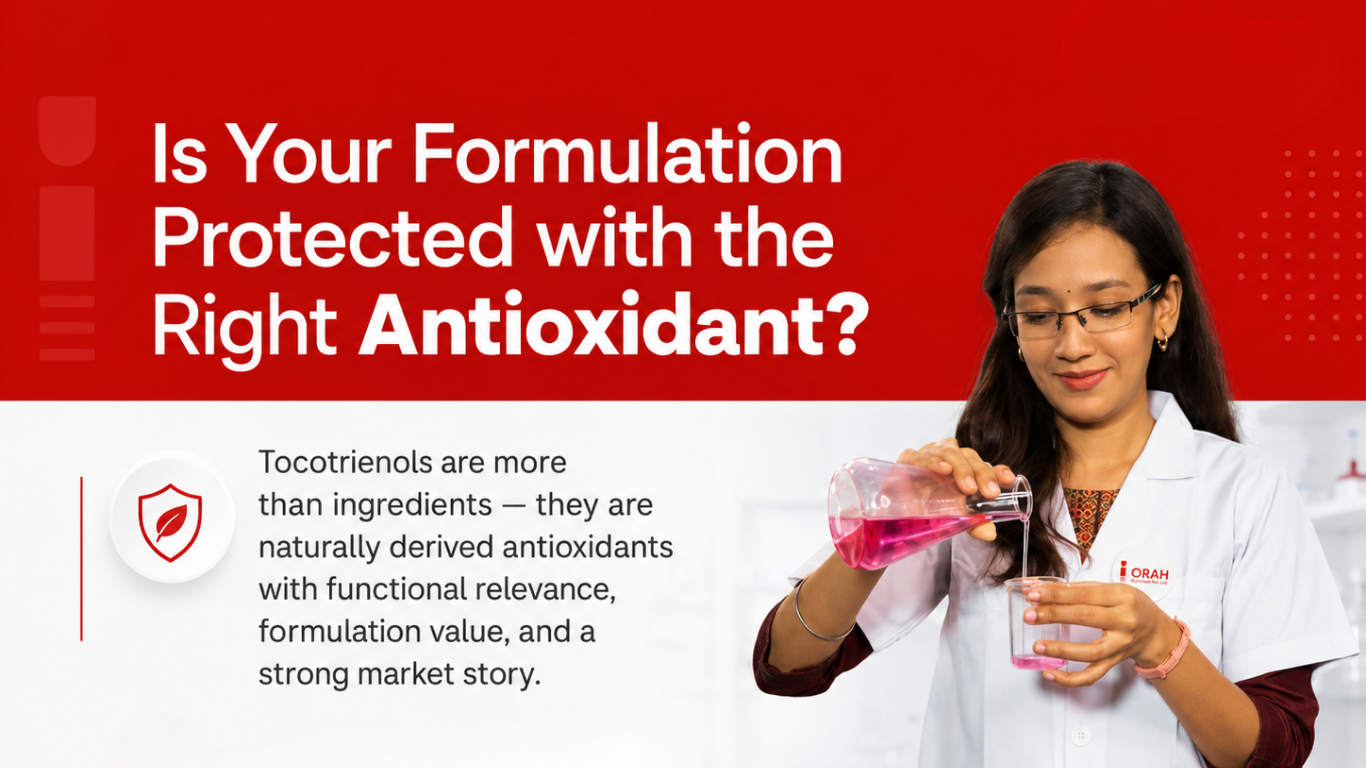
Tocotrienols are not just ingredients. They represent a massive step forward in natural antioxidant strategy—delivering verifiable clinical potential, massive market relevance, and a compelling story of scientific purity in every single drop.
FAQs
Tocotrienols are powerful natural antioxidants from the Vitamin E family that can help protect formulations against lipid oxidation, rancidity, and free-radical damage. Their molecular structure allows them to move efficiently through lipid environments, making them particularly relevant for formulations containing sensitive oils and fats.
Tocopherols have a saturated side chain, while tocotrienols have an unsaturated side chain containing three double bonds. This structural difference gives tocotrienols greater mobility within lipid environments and influences their antioxidant activity.
Tocotrienols can help intercept reactive oxygen species and reduce lipid peroxidation and oxidative degradation. This makes them particularly useful in formulations containing PUFAs, botanical extracts, oils, and other oxidation-sensitive ingredients.
Yes. By helping protect lipids from oxidation, tocotrienols can support oxidative stability and shelf-life preservation in suitable food, nutraceutical, and cosmetic formulations. Actual shelf-life performance depends on the formulation, dosage, processing conditions, packaging, and storage environment.
Tocotrienols provide formulators with a naturally derived antioxidant option for protecting sensitive oils and lipids against oxidation. This can be valuable in clean-label foods where manufacturers are looking to reduce reliance on synthetic antioxidant systems.