Beyond 'Vitamin E': Understanding the Different Molecules Behind the Name
Vitamin E is one of the most familiar names in nutrition and personal care, yet the term hides an important level of chemical diversity. The natural vitamin E family includes eight related compounds: four tocopherols and four tocotrienols. Each subgroup contains alpha, beta, gamma and delta forms. Understanding this family structure is the first step toward understanding why different vitamin E ingredients can have different properties and applications.
What is vitamin E?
Vitamin E is a collective term used for a group of fat-soluble tocochromanols. Scientific and regulatory definitions can differ depending on context. For example, nutritional reference values may focus on alpha-tocopherol, while chemistry and food composition literature often discusses the wider family of eight compounds. Being precise about the context prevents confusion.
The eight members of the natural vitamin E family
The family can be organised into two subgroups. Tocopherols include alpha-, beta-, gamma- and delta-tocopherol. Tocotrienols include alpha-, beta-, gamma- and delta-tocotrienol. All share a chromanol head group, while their side-chain structures differ.
Tocopherols: the familiar subgroup
Tocopherols have a saturated phytyl side chain. Alpha-tocopherol is the most prominent form in human nutrition and is preferentially retained by the body through specific transport mechanisms. Gamma- and delta-tocopherol are also studied for their biological properties.
Tocotrienols: the differentiated subgroup
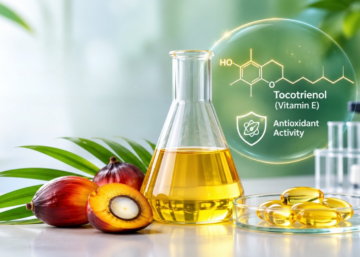
Tocotrienols have an unsaturated isoprenoid side chain containing three double bonds. This structural difference affects their physical and biological behaviour and is one reason tocotrienols are studied separately. Their natural occurrence is especially notable in certain plant oils and grains.
Why molecular structure matters
Small structural differences can influence solubility, membrane interaction, metabolism, stability and biological activity. In ingredient science, structure is therefore the starting point for understanding function. However, structure alone cannot determine finished-product performance.
Vitamin E sources
Different botanical sources contain different vitamin E profiles. Vegetable oils, grains, nuts and seeds can contain tocopherols, while some materials are particularly notable for tocotrienols. Source and processing determine the final commercial ingredient composition.
Why formulators need more than the name 'vitamin E'
An R&D team needs to know exactly which molecule or mixture is being used, at what concentration, with what purity and in what delivery format. The ingredient specification should provide enough information to connect the raw material to the intended formulation.
From vitamin E science to Orah ingredient solutions
A science-led ingredient company can make vitamin E easier to understand by connecting chemistry, source, quality and application. Orah Nutrichem’s content can use the vitamin E family as a knowledge platform and then guide professional readers toward specific ingredient solutions relevant to nutraceutical and cosmetic development.
Conclusion
The phrase ‘vitamin E’ represents a family, not a single molecule. Tocopherols and tocotrienols share important characteristics but differ structurally and functionally. Understanding these differences helps formulators select ingredients more intelligently and helps brands communicate with greater scientific clarity.
FAQs
Tocotrienol is a subgroup of the vitamin E family comprising alpha-, beta-, gamma- and delta-tocotrienol.
Yes. Tocotrienols are members of the naturally occurring vitamin E family.
The key structural distinction is the side chain: tocopherols have a saturated phytyl side chain, while tocotrienols have an unsaturated isoprenoid side chain.
Research has investigated their antioxidant activity, metabolism, membrane behaviour and other biological properties. The strength of evidence varies by outcome and study type.
Source, identity, total concentration, isomer profile, purity, analytical method, stability, storage, regulatory documentation and application suitability are useful starting points.