From Nature to Formulation: How Natural Vitamin E Adds Value to Modern Products
The phrase ‘natural vitamin E’ is increasingly visible across nutrition, cosmetics and ingredient markets. But natural sourcing is only the beginning of the ingredient story. For formulators, what matters next is composition, purity, concentration, stability, analytical verification and suitability for the finished product. Understanding the journey from natural source to functional ingredient helps R&D teams make more informed decisions.
What is natural vitamin E?
Vitamin E is a family of related fat-soluble compounds. Natural materials can contain different tocopherols and tocotrienols in varying proportions. The composition depends on the source and processing method. Therefore, natural vitamin E should be described with enough technical detail to explain what the ingredient actually contains.
From botanical source to ingredient
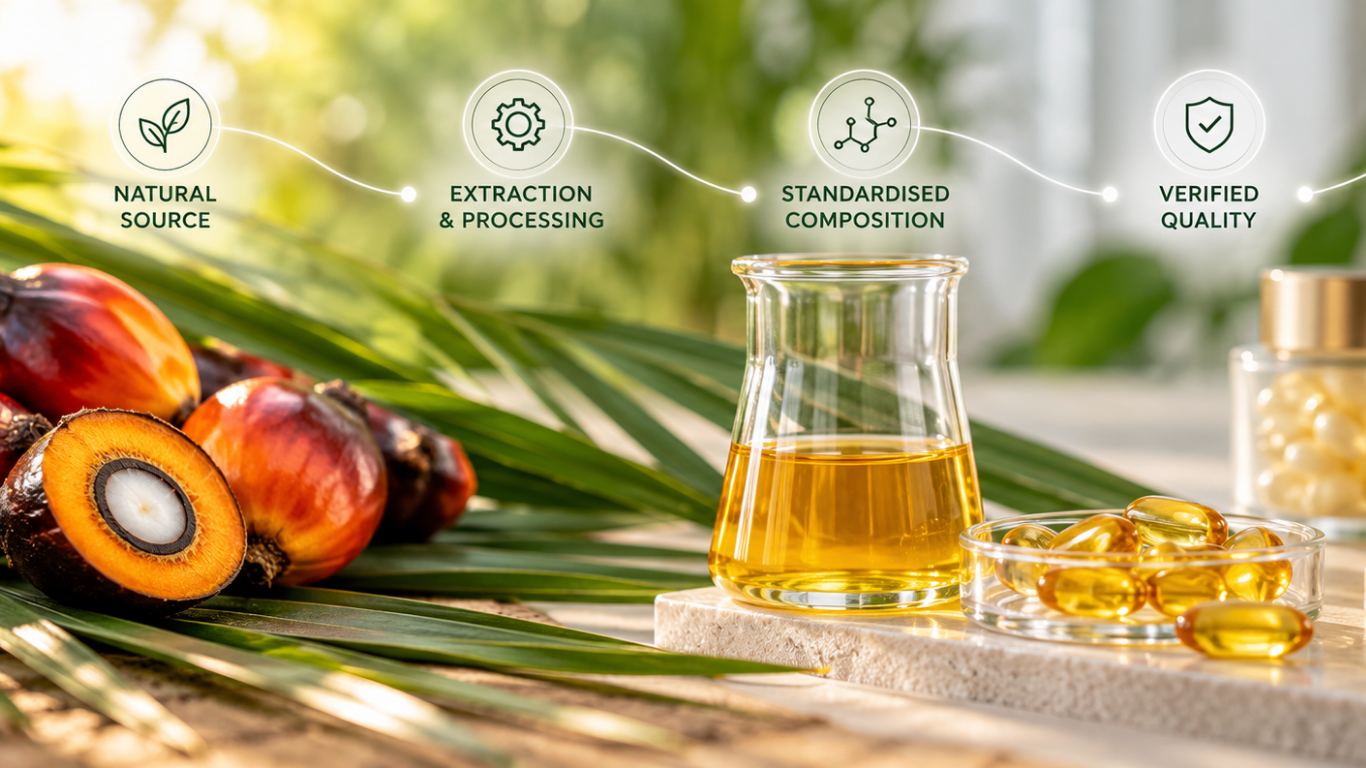
Plant oils and other botanical materials can contain vitamin E compounds. Extraction, concentration, purification and other processing steps determine the final ingredient profile. For ingredient buyers, traceability and manufacturing information are important because they connect the final specification to the original source.
Why composition matters
Two ingredients may both be described as natural vitamin E while having very different compositions. One may be rich in alpha-tocopherol; another may contain a significant proportion of tocotrienols. The difference can affect the intended application, dosage calculations, claims strategy and analytical testing. This is why a detailed specification is more useful than a generic ingredient name.
Natural does not mean unstandardised
Natural ingredients can be highly standardised. Standardisation is the process of controlling an ingredient to a defined composition or quality specification. For commercial formulation, consistency is essential. A natural ingredient that varies too widely from batch to batch can create challenges in dosage, sensory profile, stability and finished-product performance.
Natural vitamin E in nutraceuticals
In nutraceutical applications, natural vitamin E ingredients may be selected based on the target vitamin E profile, dosage form, source preference and regulatory requirements. R&D teams should evaluate the ingredient according to the nutritional role and permitted claims in the target market.
Natural vitamin E in cosmetics
In cosmetics, natural vitamin E can support a broader natural-origin formulation story while also providing functional value. But the cosmetic formulator still needs to assess compatibility, stability, odour, colour, solubility, processing conditions and packaging. Natural origin does not remove the need for formulation science.
What does quality look like?
Quality begins with identity and continues through compositional analysis, contaminant control, storage and stability. A robust technical dossier should provide the information necessary for R&D and quality teams to make an informed decision. Depending on the ingredient and market, documentation may include specification, certificate of analysis, safety data, regulatory statements and supporting technical information.
From nature to formulation: the Orah approach
For a science-led ingredient company, natural sourcing should be connected to measurable quality. The story is not simply ‘natural is better’. The stronger story is: understand the source, control the composition, verify the quality and formulate with purpose. This approach aligns natural ingredient positioning with the expectations of professional R&D teams.
Conclusion
Natural vitamin E is best understood as a combination of source, chemistry, processing and quality. When these elements are clearly communicated, manufacturers can evaluate natural vitamin E ingredients with confidence and select the profile that fits their product. For Orah Nutrichem, this is an opportunity to connect the power of nature with the precision of formulation science.
FAQs
Tocotrienol is a subgroup of the vitamin E family comprising alpha-, beta-, gamma- and delta-tocotrienol.
Yes. Tocotrienols are members of the naturally occurring vitamin E family.
The key structural distinction is the side chain: tocopherols have a saturated phytyl side chain, while tocotrienols have an unsaturated isoprenoid side chain.
Research has investigated their antioxidant activity, metabolism, membrane behaviour and other biological properties. The strength of evidence varies by outcome and study type.
Source, identity, total concentration, isomer profile, purity, analytical method, stability, storage, regulatory documentation and application suitability are useful starting points.