Why Source Matters in Vitamin E Ingredients
When selecting a vitamin E ingredient, source is an important starting point—but it is not the whole decision. The botanical origin can influence the natural composition of tocopherols and tocotrienols, while processing can influence concentration, purity and stability. For nutraceutical and cosmetic manufacturers, understanding source helps connect the ingredient’s origin to its final technical specification.
Where does natural vitamin E come from?
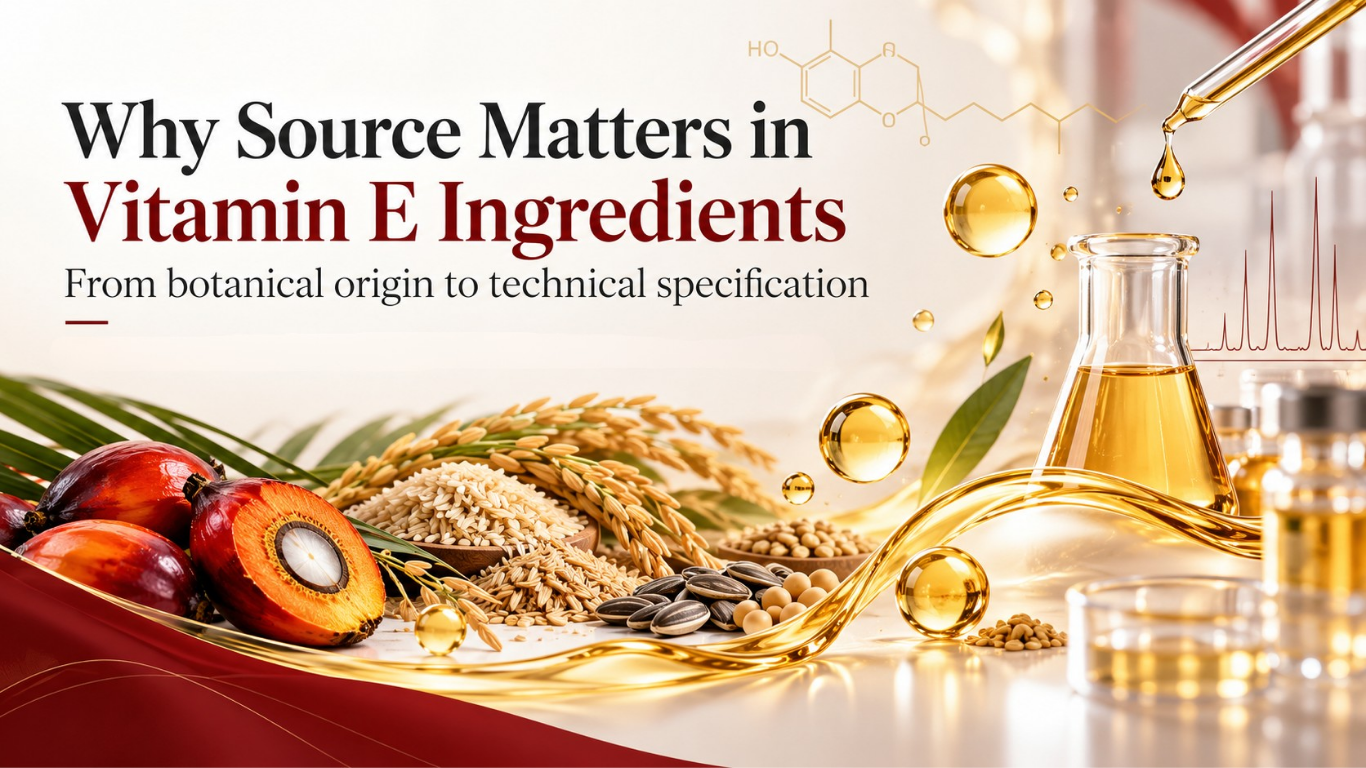
Vitamin E compounds occur naturally in plant materials. Scientific literature identifies tocotrienols in sources including palm, rice bran, barley and other plant-derived materials, while tocopherols are widely distributed across vegetable oils, nuts, seeds and grains. The exact profile varies by source.
Does source affect composition?
Yes. Different botanical sources can have different ratios of tocopherol and tocotrienol isomers. Even within the same broad source category, cultivar, geography, growing conditions and processing can contribute to variation. This is why ingredient specifications should identify the actual composition rather than relying on a source name alone.
Why does extraction matter?
Extraction and downstream purification influence what remains in the final ingredient. Different technologies may produce different concentrations, co-components and physical characteristics. For a formulation team, understanding the manufacturing process can help explain differences in colour, odour, viscosity, concentration and stability.
Natural versus synthetic: what should buyers compare?
The comparison should be specific rather than ideological. Buyers should compare chemical form, composition, source, purity, stereochemistry where relevant, regulatory status, performance and intended application. A ‘natural versus synthetic’ label is not sufficient to determine formulation suitability.
What should a supplier provide?
A professional technical package should answer questions about identity, composition, specification, analytical method, shelf life, storage, manufacturing origin and regulatory documentation. Depending on the market, additional information may be required for allergens, contaminants, residual solvents, GMO status or other quality attributes.
Why traceability matters
Traceability helps quality teams investigate variability and maintain confidence in a raw-material supply chain. It becomes particularly important for natural ingredients because botanical materials can have inherent variation. Consistent sourcing and appropriate quality controls can help manage this variability.
Source, science and formulation
For Orah Nutrichem, the strongest message is not that one source is automatically superior. It is that source should be understood. When the source is connected to analytical data and formulation performance, the ingredient story becomes meaningful to R&D teams.
Conclusion
Source matters because it influences composition, manufacturing decisions and the final technical profile of a vitamin E ingredient. The right approach is to connect botanical origin with analytical verification, quality controls and application suitability. That is the bridge between a natural ingredient story and professional formulation science.
FAQs
Tocotrienol is a subgroup of the vitamin E family comprising alpha-, beta-, gamma- and delta-tocotrienol.
Yes. Tocotrienols are members of the naturally occurring vitamin E family.
The key structural distinction is the side chain: tocopherols have a saturated phytyl side chain, while tocotrienols have an unsaturated isoprenoid side chain.
Research has investigated their antioxidant activity, metabolism, membrane behaviour and other biological properties. The strength of evidence varies by outcome and study type.
Source, identity, total concentration, isomer profile, purity, analytical method, stability, storage, regulatory documentation and application suitability are useful starting points.